Democrats at War With Themselves? Party Divisions Explode Ahead of 2026 Midterms
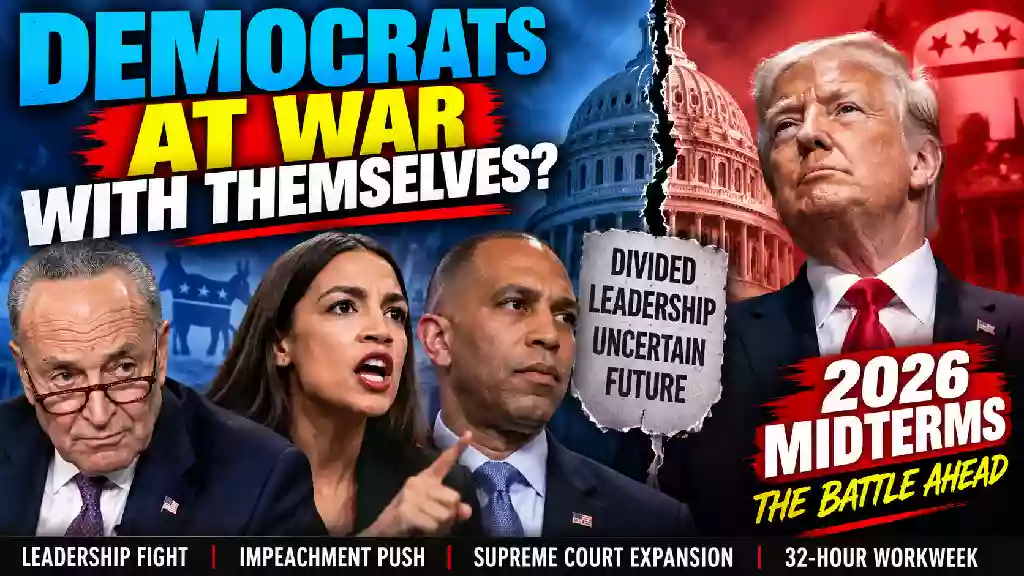
Democrats face an internal leadership battle as the 2026 midterm elections approach.
Democrats at War With Themselves? Party Divisions Explode Ahead of 2026 Midterms
Progressives vs Party Establishment: Democrats Face a Growing Leadership Showdown
The Democratic Party is heading toward the 2026 midterm elections with a major political challenge unfolding inside its own ranks. A growing divide between progressive lawmakers and the party establishment is raising questions about Democratic leadership, unity and the direction the party wants to take.
The political commentary examined here portrays a party struggling to reconcile competing factions while Republicans focus on expanding their campaign operations ahead of a critical election.
At the center of the dispute are longtime Democratic leaders, progressive activists and a younger generation of lawmakers demanding what they describe as new ideas.
Chuck Schumer Faces Pressure From the Democratic Left
One of the clearest examples of the internal Democratic divide involves Senate Minority Leader Chuck Schumer.
During an exchange discussed in the source, a Democratic candidate was asked whether she would support Schumer for majority leader. Her response was direct: she said she did not support him and argued that Democrats need new ideas.
The commentary connects that disagreement to the party’s much larger ideological struggle between its establishment and progressive wings.
It also draws a line back to the long-running political conflict surrounding Bernie Sanders and Hillary Clinton, suggesting that the tensions that emerged during that era continue to influence Democratic politics today.
For progressives who believe the Democratic establishment has resisted their agenda, the coming elections could provide an opportunity for a new generation of lawmakers to demand greater influence.
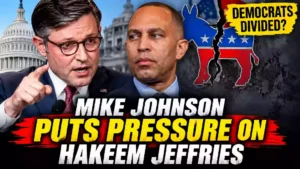
Hakeem Jeffries Faces the Challenge of Holding Democrats Together
House Democratic Leader Hakeem Jeffries is also portrayed as facing a difficult balancing act.
The source describes disagreements between Democratic leadership and progressive members who have resisted efforts to maintain party discipline. One example cited involves comments from Pramila Jayapal, who rejected the idea that Democratic leadership should treat lawmakers like children who simply need to follow orders.
That resistance creates a difficult problem for Jeffries: how can Democratic leadership maintain unity without alienating members of its increasingly diverse ideological coalition?
The discussion also raises the possibility of consequences for lawmakers who fail to financially support the Democratic Congressional Campaign Committee or who break with the party on major procedural votes.
Such measures could potentially affect leadership opportunities and campaign resources.
Yet Jeffries is presented as emphasizing cooperation, describing the situation as a discussion about how Democrats can move forward together rather than an immediate push for punishment.
Trump, Impeachment and a Potential Supreme Court Fight
The Democratic debate extends beyond party leadership and into the future of the federal government.
The source discusses calls for impeaching President Donald Trump, with Democratic arguments focusing on alleged constitutional violations. However, the commentary questions whether those arguments identify a specific and clearly defined basis for impeachment.
The discussion then turns to the controversial idea of expanding the Supreme Court.
Progressive lawmakers have argued that adding justices could be used to address concerns about the court’s direction and restore what they view as institutional balance. Critics see court expansion as an aggressive political move that could fundamentally change the Supreme Court.
Together, these issues demonstrate how dramatically different the competing visions inside the Democratic Party can be.
The 32-Hour Workweek Becomes Another Flashpoint
Economic policy provides another example of the ideological divide.
The source highlights support for a 32-hour workweek, with advocates arguing that Americans should be able to meet their basic needs without sacrificing excessive amounts of personal time.
Critics, meanwhile, portray the proposal as another example of an increasingly progressive economic agenda.
The debate reflects a larger question facing Democrats: should the party move further toward ambitious progressive policies, or focus on a more moderate message designed to appeal to a broader electorate?
Republicans Are Already Looking Toward November
While Democrats debate their direction, Republicans are portrayed in the source as preparing for an aggressive 2026 midterm campaign.
One Republican figure discussed plans to visit 35 targeted races and campaign directly for candidates. The objective is to build a broad electoral operation capable of competing across multiple states.
The Republican message highlighted in the source also emphasizes manufacturing, engineering, entrepreneurship and skilled trades.
Rather than simply focusing on traditional political rhetoric, the argument is that America should encourage young people to build businesses, manufacture products and develop careers in skilled industries.
The 2026 Midterms Could Expose the Party Divide
The 2026 midterm elections will provide a major test for both parties.
For Democrats, the challenge is not simply defeating Republicans. They must also determine whether their progressive and establishment factions can work together effectively enough to present voters with a unified political message.
For Republicans, the challenge will be converting campaign organization, candidate recruitment and economic messaging into victories at the ballot box.
The political commentary ultimately paints a dramatic picture: Democrats are wrestling with an internal battle over their identity while Republicans are attempting to capitalize on that division.
Whether the Democratic Party can overcome those disagreements—or whether the internal conflict becomes a defining issue of the 2026 election—could have major consequences when voters head to the polls.
#2026Midterms #Democrats #DemocraticParty #Republicans #USPolitics #ChuckSchumer #HakeemJeffries #DonaldTrump #MidtermElections #Election2026 #Congress #PoliticalNews