West Virginia Bets on Data Centers to Boost the Economy and Lower Taxes
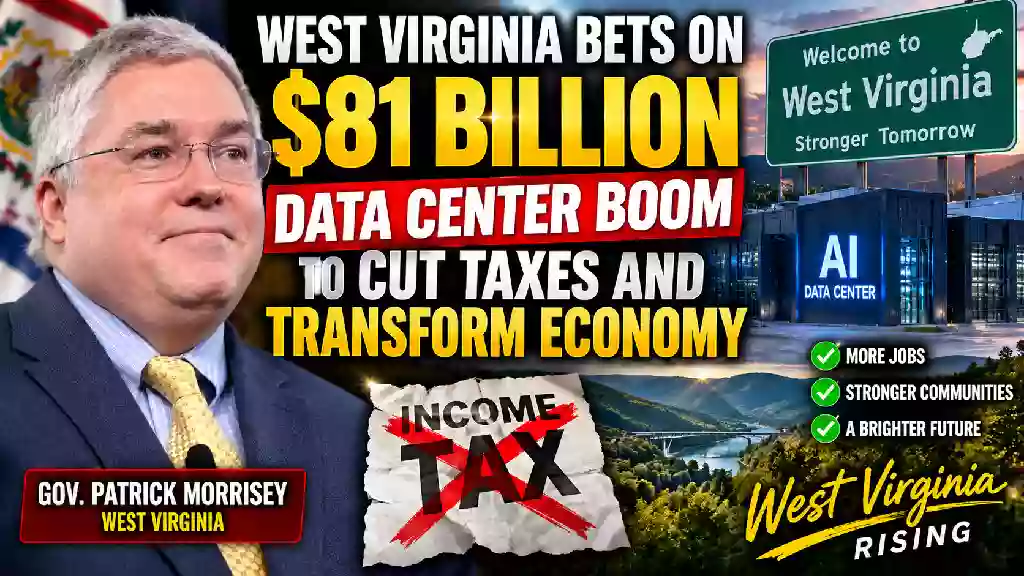
West Virginia Gov. Patrick Morrisey promotes an $81 billion data center investment strategy aimed at growing the economy, protecting consumers and potentially lowering state income taxes.
West Virginia Bets on Data Centers to Boost the Economy and Lower Taxes
West Virginia Bets on $81 Billion Data Center Boom to Cut Taxes and Transform Economy
West Virginia is taking a different approach to the growing national debate over data centers, artificial intelligence and the infrastructure needed to power the digital economy. While opposition to large-scale data center development has increased in parts of the country, Governor Patrick Morrisey says West Virginia is positioning itself to capture the economic benefits while protecting residents from higher utility costs and excessive demands on water resources.
Morrisey recently unveiled West Virginia’s Responsible Data Center Plan, which is designed around several key priorities. The plan focuses on protecting the state’s water and power grids, requiring developers to pay for their own infrastructure, and directing a portion of the tax revenue generated by data center development toward reducing or potentially eliminating the state income tax.
$81 Billion in New Investment
According to Morrisey, West Virginia is already seeing significant interest from companies looking to invest in data centers and related infrastructure. The governor cited another $81 billion in new investment announced for the state and emphasized that protecting existing ratepayers is a central part of the strategy.
Morrisey said the state intends to ensure that consumers are protected from increases in their power bills as these major projects move forward. The governor argues that data center investment should not result in ordinary households paying more for electricity.
The strategy is intended to make West Virginia competitive for the rapidly expanding artificial intelligence and technology industries while ensuring that economic benefits extend beyond the companies building the facilities.
Protecting West Virginia’s Water Resources
Water usage has become one of the biggest concerns surrounding large data centers. These facilities can require substantial infrastructure and resources, making water management an important issue for communities considering new development.
West Virginia’s plan calls for the use of closed water loops and circuits designed to minimize water consumption. Morrisey said the approach is intended to ensure that water use remains minimal while maintaining clean and safe water supplies.
The governor says West Virginia studied mistakes made by other states before developing its own policies. Rather than simply offering companies large tax incentives, the state says it wants to establish infrastructure and safeguards that benefit residents as well as developers.
Could Data Centers Help Eliminate the State Income Tax?
One of the most ambitious elements of the plan is the proposal to use additional tax revenue from data center development to reduce and eventually eliminate West Virginia’s state income tax.
Morrisey described the creation of a separate fund designed to dramatically lower the income tax over time. He characterized the approach as a way to make sure the financial benefits of major data center projects reach people throughout the state rather than remaining concentrated among developers and technology companies.
The proposal could make West Virginia an especially attractive destination for companies seeking locations with energy resources, available infrastructure and a business-friendly environment.
Infrastructure Investment Is a Major Priority
Morrisey also emphasized that West Virginia is not relying solely on tax incentives to attract data center companies. Instead, the state plans to invest in basic infrastructure, including water and sewer systems, roads and bridges, and broadband.
The governor said this approach is intended to address infrastructure needs that benefit communities regardless of whether a particular data center project is located nearby.
West Virginia is also promoting what Morrisey calls “speed to build,” an effort to reduce regulatory delays and cut red tape so projects can be developed more quickly than in competing states.
Skepticism Remains Over Data Center Benefits
Despite the potential economic benefits, questions remain about whether the promises surrounding data center development will ultimately materialize. During the discussion, Morrisey faced pushback over whether skeptical residents would believe the state’s promises before seeing measurable results.
The governor acknowledged that progress would take time but argued that the state can demonstrate its commitment through actual infrastructure improvements, consumer protections and economic results.
Morrisey said West Virginia intends to ensure that data center projects go through a rigorous process and that the state will hold companies accountable when projects fail to meet expectations.
A New Test for West Virginia’s Economic Future
West Virginia’s data center strategy represents a major bet on artificial intelligence, technology and the state’s energy resources. If successful, the approach could bring billions of dollars in investment while supporting infrastructure improvements, communities, teachers, law enforcement and taxpayers.
For now, the biggest question is whether West Virginia can deliver on its promise to balance rapid data center growth with affordable electricity, responsible water use and broad economic benefits.
As AI continues to expand and demand for data centers grows, West Virginia is positioning itself as a state willing to welcome the industry—but on terms designed to make residents part of the economic payoff.
#WestVirginia #DataCenters #PatrickMorrisey #ArtificialIntelligence #AI #TechInvestment #EconomicDevelopment #WestVirginiaEconomy #DataCenterInvestment #Infrastructure #TaxReform